AI · Oct 21, 2026
OpenAI on Google Cloud lets companies spend Google commitments on GPT-6, and that changes procurementBaker lab uses AI design tools to build protein-cutting enzymes from scratch, with lab screening to boost activity
· Updated · Signal Desk newsroom
Analysis of reporting by Ars Technica. How we work
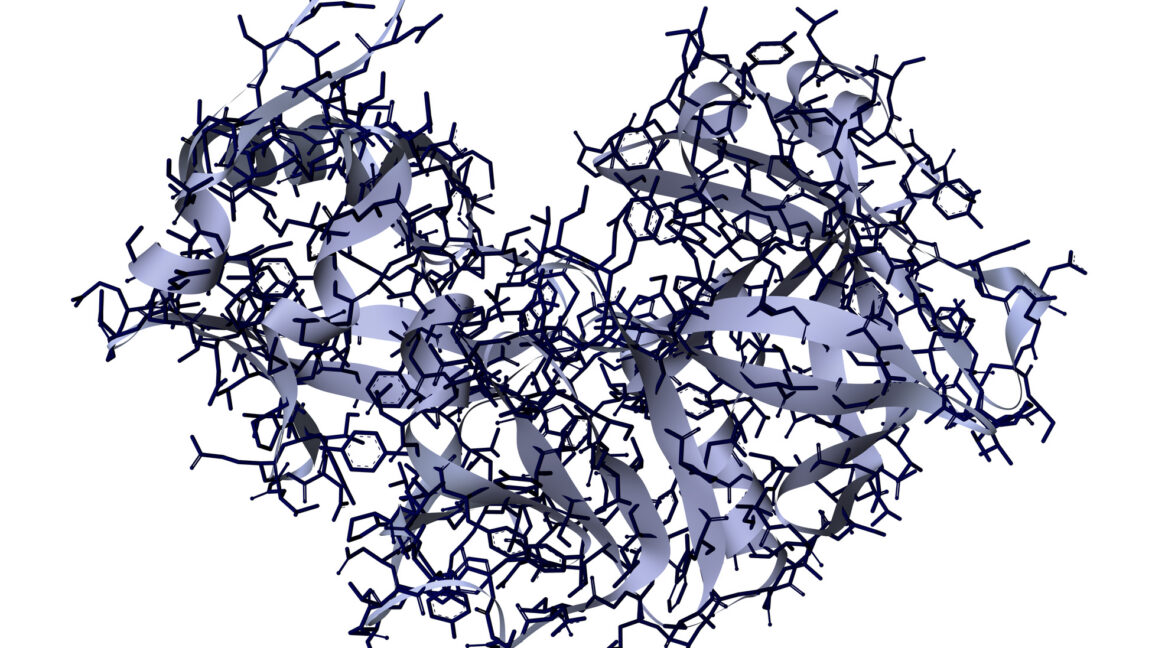
Researchers mainly from David Baker’s lab at the University of Washington used RFdiffusion2 and ProteinMPNN to design new proteases that cut chosen target sequences, reported in two Nature papers. The software handled structure; targeted mutations were needed to reach high activity.
Key takeaways
- The team designed new proteases, enzymes that break peptide bonds, using RFdiffusion2 and ProteinMPNN.
- Designs started from catalytic cores of a crayfish zinc protease and a yeast cysteine protease.
- Initial designs worked but were far less active than natural enzymes.
- After targeted mutations, the best sped up cleavage by a billion to ten billion times while staying specific.
- Some designed zinc proteases cut proteins linked to Alzheimer’s and frontotemporal dementia in cells.
What the researchers built
Ars Technica reports that researchers mainly from David Baker’s lab at the University of Washington used the AI design tools RFdiffusion2 and ProteinMPNN to create new proteases, enzymes that break peptide bonds. Those bonds are otherwise stable for hundreds of years in water, so cutting them on demand requires precise chemistry. Starting from the catalytic cores of a crayfish zinc protease and a yeast cysteine protease, the team designed entirely new surrounding structures tuned to cut specific target sequences. The results appear in two Nature papers.
The first designs worked but were much less active than natural enzymes. After targeted mutations, the best versions accelerated peptide-bond cleavage by factors of a billion to ten billion while remaining specific to their targets. The team also designed zinc proteases that cut proteins associated with Alzheimer’s disease and frontotemporal dementia in cells. Baker shared the 2024 Nobel Prize in Chemistry for computational protein design, and RFdiffusion and ProteinMPNN are open tools widely used in the field.
Structure from software, activity from experiments
Designing a functioning enzyme, one that performs precise chemistry on a chosen target rather than simply folding correctly, is a hard problem, and the tools cleared a significant part of it. The authors are candid about the limits: the software satisfied every physical constraint but could not be directed to produce a specific level of catalytic activity. Conventional mutation screening turned the designs into effective enzymes. AI handled the architecture, and experiments delivered the performance.
The disease applications are promising but distant. Ars outlines the hurdles: delivering proteins where they are needed, immune responses, and likely gene delivery for targets inside cells. Therapy discussion is best read as a research direction rather than a timeline.
Dual use and oversight
Any tool that designs proteins to cut other proteins carries dual-use questions, and biosecurity screening and responsible release practices need to develop alongside capabilities like this. Provenance tools are one response; Google has proposed watermarking AI-designed proteins (protein watermarking, SynthID Bio). Related biosecurity concerns about AI-designed biology are covered in our roundtable with the creator of AI-designed viruses (AI-designed viruses).
Design tools that can target catalytic activity directly, animal studies on disease-protein targeting, and biosecurity guidance for enzyme design are the developments to follow. The trajectory points toward custom enzymes for medicine, industry and research. More in our research coverage, healthcare coverage and AI coverage.
Who feels it
- Biomedical researchers
- A route to custom proteases targeting disease-linked proteins.
- Industrial biotech
- Designer enzymes for tailored protein processing.
- Biosecurity community
- More capable design tools raise screening questions.
What to watch
- Tools that target catalytic activity, not just structure.
- Animal studies on disease-protein targeting.
- Biosecurity guidance for enzyme design.
FAQ
What did the researchers design?
New proteases, enzymes that cut specific protein sequences, using AI design tools.
Which AI tools were used?
RFdiffusion2 and ProteinMPNN.
Did the AI designs work immediately?
They worked but were weak; targeted mutations raised activity by a billion to ten billion times.
Could this treat Alzheimer’s?
Some designs cut Alzheimer’s-linked proteins in cells, but delivery and immune hurdles remain.
More on AI
AI · Oct 14, 2026
White Circle says newer OpenAI and Google image models are easier to jailbreak than their predecessorsAI · Oct 19, 2026
Microsoft ships Guardian Agents, saying frontier models ‘can’t be trusted’AI · Oct 13, 2026
After months off the frontier, Google ships Gemini 4 Argon with benchmark claims and aggressive pricingAI · Oct 28, 2026
RTX Spark laptops get open speech models and a dial for background agents