AI · Oct 28, 2026
Thin, Light and Built for Everything: NVIDIA RTX Spark Windows Laptops Gain New Models, Agent Tools and GamesNvidia says the AI memory crunch is solved by codesign, not more HBM, citing 30x throughput per dollar
· Updated · Signal Desk newsroom
Analysis of reporting by NVIDIA Blog. How we work
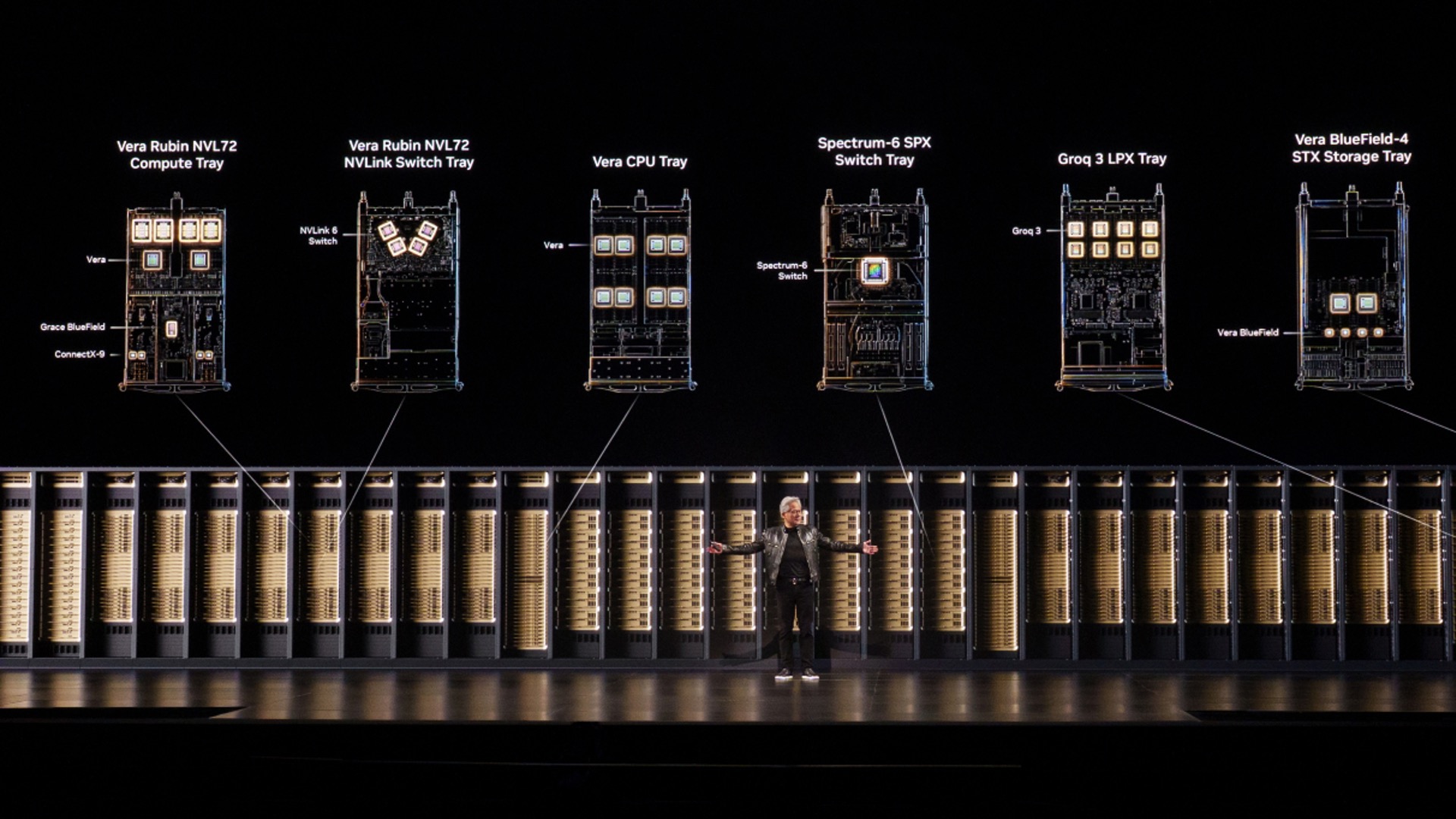
From Blackwell Ultra to Vera Rubin, Nvidia says HBM per GPU rose about 3% while agentic throughput per dollar rose up to 30x on SemiAnalysis AgentX. Its answer is a memory hierarchy, compact formats and KV-cache offload. The direction is right; the numbers need outside checks.
Key takeaways
- Nvidia says HBM capacity per GPU rose roughly 3% from Blackwell Ultra to Vera Rubin.
- It claims agentic throughput per dollar rose up to 30x on SemiAnalysis AgentX.
- The hierarchy runs HBM for hot weights and KV cache, then CPU memory, local SSDs and shared context storage.
- Tools include NVFP4, NVL72 weight spreading, Vera CPU over NVLink-C2C, Dynamo and CMX storage.
- Comparisons are vendor-chosen; independent reproduction is pending.
The squeeze
Bigger models, longer contexts and agentic trajectories are squeezing GPU high-bandwidth memory while supply stays tight. Agentic inference makes it worse: KV cache spans tool calls, RAG grows prompts, and trillion-parameter models compete for the same tier. Nvidia’s answer is full-stack codesign: shrink what must live in HBM, park the rest on the right cheaper tier, and fetch it before it is needed. From Blackwell Ultra to Vera Rubin, the company says HBM capacity per GPU rose roughly 3% while agentic throughput per dollar rose by up to 30x on SemiAnalysis AgentX, with GB300-versus-H200 and Vera Rubin-versus-GB300 figures anchoring the claims. Its warehouse-and-docks metaphor fits: extra HBM without bandwidth and orchestration is empty aisle space that still draws power.
The toolkit
- NVFP4
- Shrinks weights and KV cache versus FP8; Nvidia lists NVFP4 releases from Black Forest Labs, Thinking Machines, Reflection, Meta, StepFun and Nemotron.
- NVL72 spreading
- Distributing weights across the rack leaves each GPU more room for cache.
- Vera CPU and NVLink-C2C
- A nearby waiting room for paused context (Vera).
- Dynamo and CMX
- Moves inactive KV to shared context storage with partners from Cloudian to WEKA.
- Nemotron Retriever and cuVS
- Keeps RAG indexes off HBM until passages are needed.
- KV Cache Reuse
- Treats context as a system-wide resource.
Goodput over brag sheets
This mirrors Nvidia’s developer deep dive on five codesign levers (five levers) and its split of long-context inference across Rubin GPUs and Groq LPX (Groq 3 LPX). AI factories should optimize useful tokens inside a power envelope, so operators buying on tokens per watt rather than gigabytes of HBM is healthy. Nvidia also cites first-mover adoption of HBM3e and HBM4.
Vendor-chosen AgentX comparisons deserve care. The bigger risk is codesign becoming synonymous with one vendor’s hierarchy, so switching costs calcify and alternative memory architectures struggle, the same lock-in dynamic seen in Nvidia’s networking consolidation (GPUNetIO). Useful efficiency is service-level tokens delivered without overstating capacity; measure goodput, not installed HBM. More in our Nvidia coverage and business coverage.
Who feels it
- AI factory operators
- More concurrent users from constrained HBM budgets.
- Model builders
- Incentive to ship NVFP4 checkpoints.
- Storage partners
- Demand for short-lived KV context tiers.
- Rival silicon vendors
- Pressure to publish hierarchy-aware efficiency.
What to watch
- Independent reproduction of the 30x claim.
- Dynamo KV offload to CMX under production SLAs.
- HBM pricing and supply into 2027.
- Whether NVFP4 becomes a default release format.
FAQ
How is Nvidia addressing the HBM shortage?
By codesigning a memory hierarchy, compact NVFP4 formats and KV-cache offload so less must sit in HBM.
Did HBM per GPU grow with Vera Rubin?
Nvidia says only about 3% from Blackwell Ultra, while agentic throughput per dollar rose up to 30x.
What is KV cache offload?
Moving inactive conversation context from GPU memory to CPU memory, SSDs or shared storage until it is needed.
Companies: NVIDIA
More on NVIDIA
AI · Nov 5, 2026
NVIDIA’s four open Cosmos 3 Nano models let robot and driving teams simulate worlds that reactAI · Nov 9, 2026
Nvidia’s Korean startup bets span interconnect, open models, robot hands and document AIAI · Nov 8, 2026
Nvidia’s Dynamo recipes speed four Korean open models to production, tuned for B200sAI · Nov 5, 2026
Nvidia profiles Chris Alexiuk, the YouTube teacher making the case that open AI means weights, data and recipes