AI · Nov 9, 2026
OpenAI’s Control Room puts a fail-closed kill switch inside the inference engineNvidia pitches the AI-defined chip fab with partner speedups up to 35x, but no yield data
· Updated · Signal Desk newsroom
Analysis of reporting by NVIDIA Blog. How we work
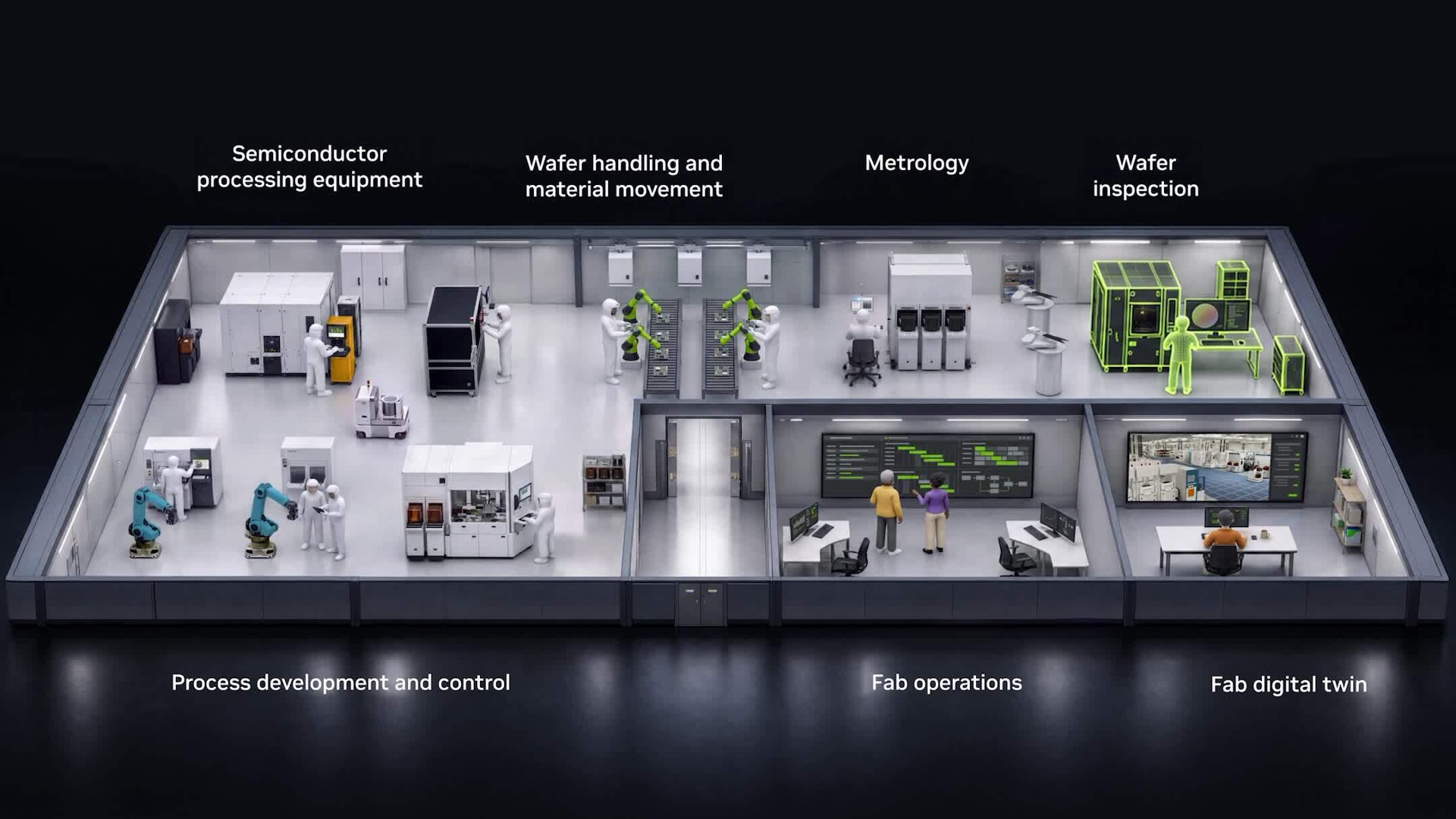
Nvidia’s post cites COMSOL, Applied Materials, Siemens and Lam Research gains from GPU simulation and physics-trained AI models. Faster prediction could let engineers test more before touching a wafer. Every figure is a vendor upper bound, with no validation or yield results.
Key takeaways
- COMSOL and Applied Materials report up to 10x faster simulation with Nvidia’s cuDSS library.
- Applied’s ACE+ reportedly runs topography simulations up to 35x faster with PhysicsNeMo.
- Siemens says cuLitho delivers up to 17x on key lithography workloads.
- Lam Research showed plasma behavior predicted in milliseconds instead of days.
- Advantest uses NeMo Switchyard agents to pick AI models on the test floor, cutting hours to minutes.
The pitch
Chipmaking is getting harder as demand rises. Engineers often wait days for simulations, and physical trials on a fab line are slow and expensive. Nvidia argues accelerated simulation, physics-trained AI models, agents and digital twins compress that wait. Computational lithography, which determines how circuit patterns print onto silicon, is too compute-heavy for CPUs at production scale, and Applied Materials uses Omniverse libraries to build digital twins of entire fabs, simulating material flow, bottlenecks, layouts and operating strategies before changes reach the floor. If gains translate to the line, more alternatives get tested before anyone touches a wafer.
Partner claims
- COMSOL and Applied Materials
- Up to 10x faster simulation with cuDSS.
- Applied ACE+
- Topography simulations up to 35x faster with PhysicsNeMo.
- Siemens
- Up to 17x on key lithography workloads with cuLitho.
- Lam Research
- Plasma behavior predicted in milliseconds instead of days for a full simulation.
- Advantest
- NeMo Switchyard agents automate choosing which AI model to apply on the test floor, cutting response times from hours to minutes.
Read it for what it is
Fabs are exactly where cheaper, faster prediction pays off, since the alternative is burning real wafers and time; a surrogate that predicts plasma in milliseconds lets engineers explore conditions they would never pay days of compute to try. But this is an Nvidia blog post: every number is an upper bound and nearly every example is a partner integrating Nvidia libraries. There are no yield figures, no error bars on learned physics models and no discussion of when fast prediction disagrees with slow simulation. In manufacturing, a confident wrong answer can be worse than a slow right one, the same caution Nvidia’s own robotics guidance gives about simulated success (SimReady). The agent example is thin: agents picking models, not running the fab.
The connected loop and dependency
The framing keeps engineers directing the work and making calls, which is right. The trajectory to watch is the connected loop, where production data feeds models that evaluate changes. That could make fabs learn faster. It also concentrates more of the industry’s core tooling on one vendor’s stack, a strategic risk for chipmakers that already depend on Nvidia as customer and supplier, and part of a pattern of Nvidia writing itself into every layer (European clouds). More in our Nvidia coverage and business coverage.
Who feels it
- Process and yield engineers
- More what-if exploration before physical trials.
- Chipmakers and equipment makers
- Toolchains converging on Nvidia raise dependency questions.
- EDA and simulation vendors
- GPU acceleration is table stakes.
What to watch
- Partner data tying speedups to yield or cycle time.
- How often surrogates diverge from full simulation.
- Agents moving into process adjustment, and the sign-off required.
FAQ
How is AI used in semiconductor fabs?
For faster simulation, physics-trained surrogate models, digital twins and agents that help engineers test changes before using wafers.
How much faster is GPU lithography?
Siemens says Nvidia cuLitho delivers up to 17x on key lithography workloads.
Are Nvidia’s fab speedups proven?
They are partner and vendor upper-bound claims, without published yield or validation data.
More on AI
AI · Oct 21, 2026
OpenAI on Google Cloud lets companies spend Google commitments on GPT-6, and that changes procurementAI · Oct 14, 2026
OpenAI, Google pushing new AI models easily tricked into making nudes, researchers sayAI · Oct 19, 2026
Microsoft says AI agents are like insider threats as ‘frontier models can’t be trusted’AI · Nov 11, 2026
OpenAI’s $2 million for children’s AI safety research matters for one promise: publishing bad news